Case Study

Harmonizing Complex IT Landscapes with Enterprise Architecture

In Short

Case Study

Harmonizing Complex IT Landscapes with Enterprise Architecture

In Short

The Challenge

As part of one of the largest corporate carve-outs in recent German industrial history, a leading enterprise had to establish its own IT governance while modernizing a heterogeneous landscape of more than 1,000 systems. All of this under tight regulatory deadlines and intense organizational pressure following a carve-out.

Our Approach

MMK DIGITAL established and operationalized a scalable Enterprise Architecture practice embedded in emerging global structures. It combined governance, standards, reference architectures, and architecture boards with hands-on support for strategic transformation initiatives.

The Outcome

The organization successfully completed its carve-out while establishing greater transparency, strategic alignment, and consistency across its technology landscape. The resulting Enterprise Architecture capability continues to support sustainable IT evolution and business growth.


Background: Building Independence at Enterprise Scale

As part of one of the largest corporate carve-outs in German industrial history, a leading global enterprise had to separate from shared corporate IT services and establish full autonomy within a compressed regulatory and contractual timeframe. The newly independent company had to separate from shared corporate IT services and establish full autonomy within a compressed regulatory and contractual timeframe.
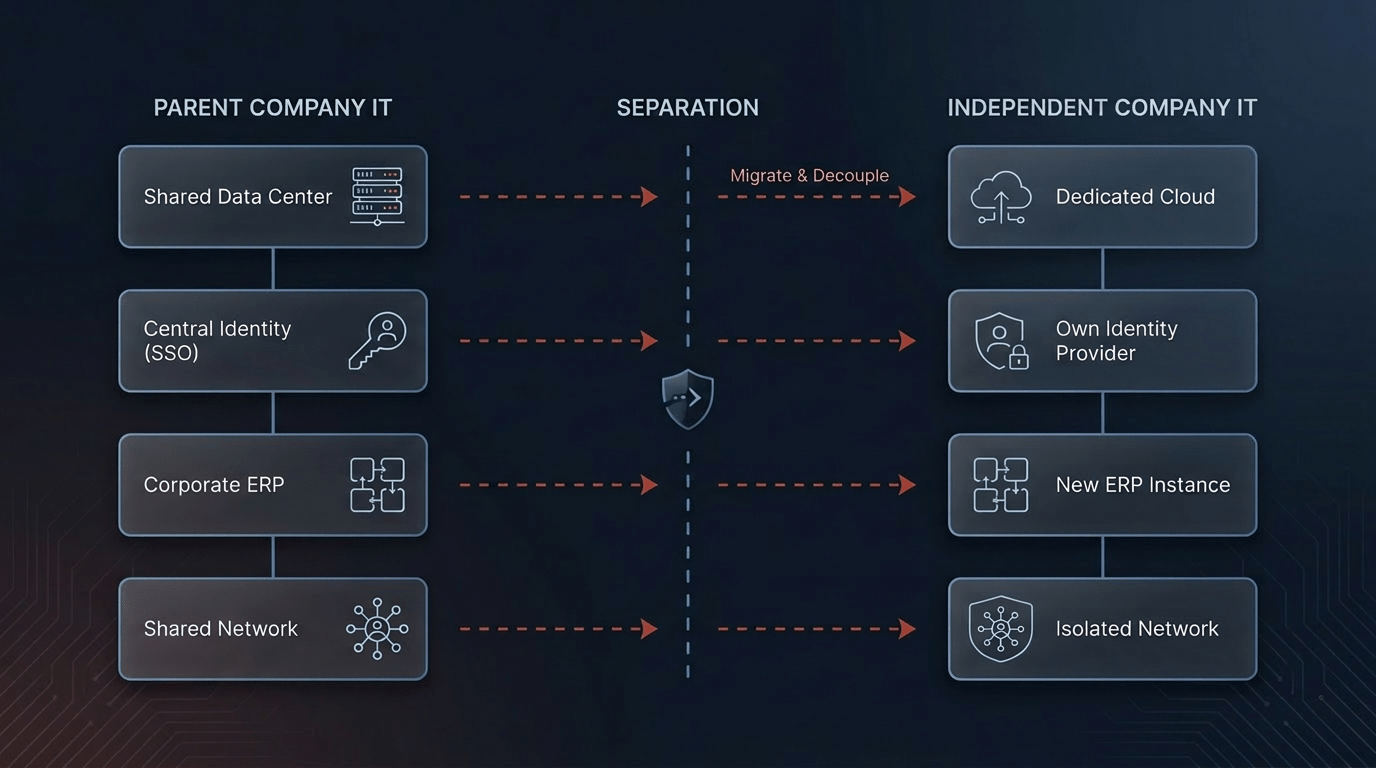
The scale was considerable. More than 1,000 IT systems, built up over decades, supported critical business capabilities across the company’s core value streams. Many relied on shared services and complex dependencies that had to be disentangled within a limited timeframe. Contractual agreements and regulatory obligations imposed strict migration deadlines, while requirements around data separation, licensing, and compliance left little room for delay.

Beyond separation, the company saw an opportunity. Rather than replicating existing structures, it aimed to modernize the landscape and lay a stronger foundation for growth. The underlying difficulty was coordination: technology decisions were made locally, with no shared principles, no common standards, and no enterprise-wide view of what was being built or why.

Large-scale carve-outs are ultimate stress tests. Success depends on the ability to maintain architectural integrity and cross-functional alignment while navigating the constant ambiguity of a decoupled business.

Benjamin Malik, Principal IT Architect

Large-scale carve-outs are ultimate stress tests. Success depends on the ability to maintain architectural integrity and cross-functional alignment while navigating the constant ambiguity of a decoupled business.

Benjamin Malik, Principal IT Architect


Pain Points: Speed Without Guardrails

Years of decentralized technology decisions had resulted in a fragmented landscape with limited governance and transparency. Responsibilities were not always clearly defined, architectural standards varied across domains, and there was no consistent view of ongoing initiatives or technology choices. As the carve-out accelerated, this lack of coordination created growing complexity, duplication of effort, and increasing delivery risk.

Different teams chose different stacks, integration patterns, and cloud services for similar problems, creating redundancy and inconsistency. There was no enterprise-wide transparency into what was being built, which standards applied, or how individual projects fit the broader target landscape. Multiple teams solved the same integration and infrastructure challenges independently, duplicating effort and budget, while point-to-point connections proliferated and made the landscape harder to maintain.
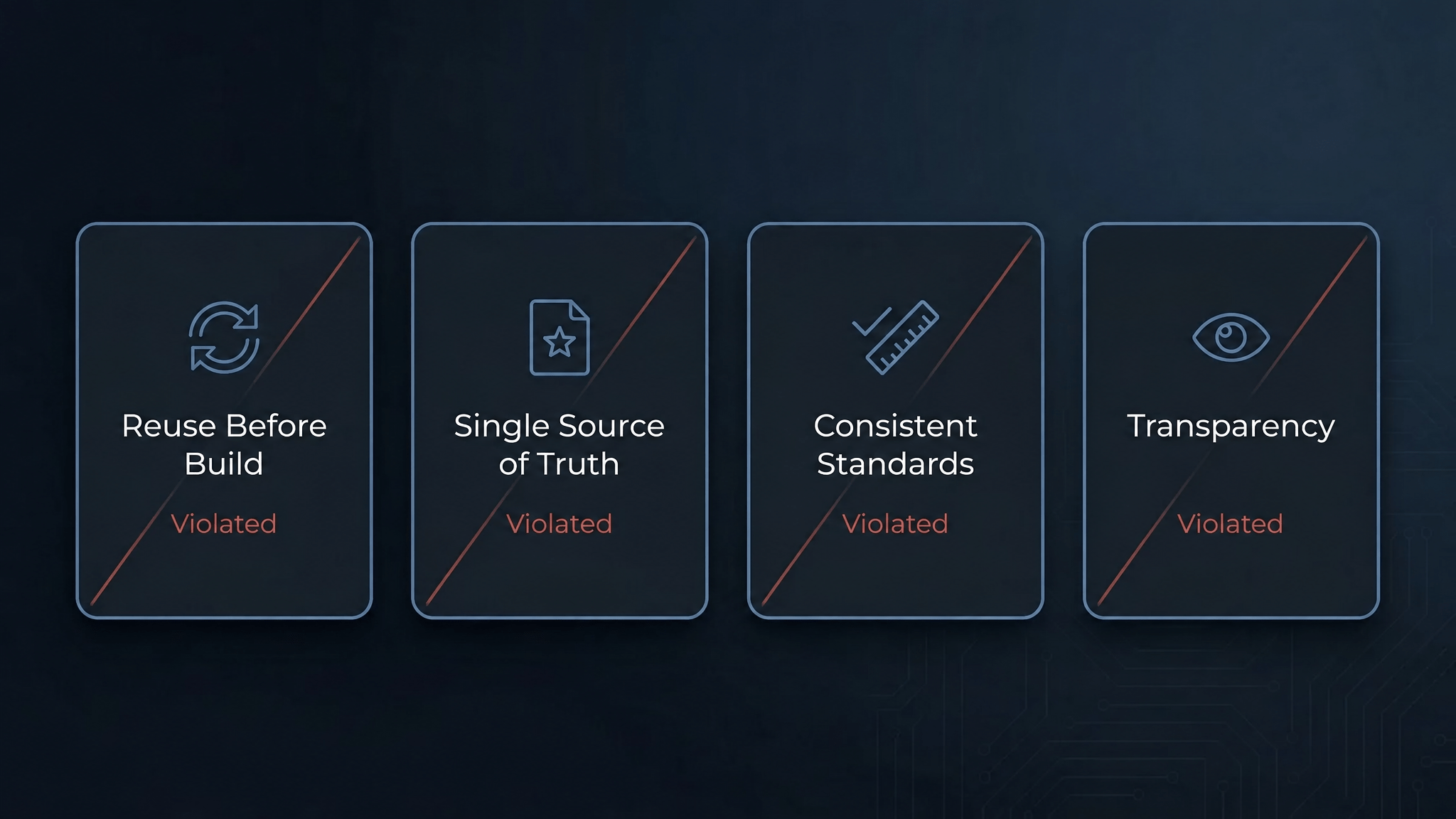
Because data separation deadlines and regulatory obligations were unforgiving, architectural missteps could become non-compliant. The landscape itself reflected decades of organic growth, with domains adopting different technologies and operating models. The challenge was therefore less about modernization than about creating alignment across hundreds of stakeholders and many domains without becoming a bottleneck.

The hardest part was building trust that governance could actually help teams move faster.

René Reichenbach, Expert IT Architect

The hardest part was building trust that governance could actually help teams move faster.

René Reichenbach, Expert IT Architect


Goals & Strategic Guidelines: Structure Without Slowdown

Success was defined by a set of practical outcomes. The organization needed guiding principles and technology standards adopted across all transformation programs, alongside review and decision processes that teams would genuinely use rather than work around. It needed reusable reference designs that accelerated delivery instead of constraining it, and full traceability of technology decisions for audit, compliance, and future planning.

Four priorities shaped the work. The first was enablement over control, with governance designed to help projects succeed rather than to act as a gatekeeper. The second was standardization with flexibility, offering common foundations where consistency mattered and autonomy where business context demanded it. The third favored the practical over the theoretical, testing every standard and blueprint against real project needs before adoption. The fourth was sustainability, building an operating model the organization could run independently long after the engagement ended. Together with the customer, MMK DIGITAL designed an Enterprise Architecture practice around these priorities, calibrated to provide structure without unnecessary overhead.

Our goal was to build something teams would actually adopt, because it made their work easier.

Clemens Müssener, Principal IT Architect

Our goal was to build something teams would actually adopt, because it made their work easier.

Clemens Müssener, Principal IT Architect


Our Contribution: Building and Operationalizing an Enterprise Architecture Practice

MMK DIGITAL worked inside the organization, combining strategic governance design with hands-on delivery across three interconnected workstreams.

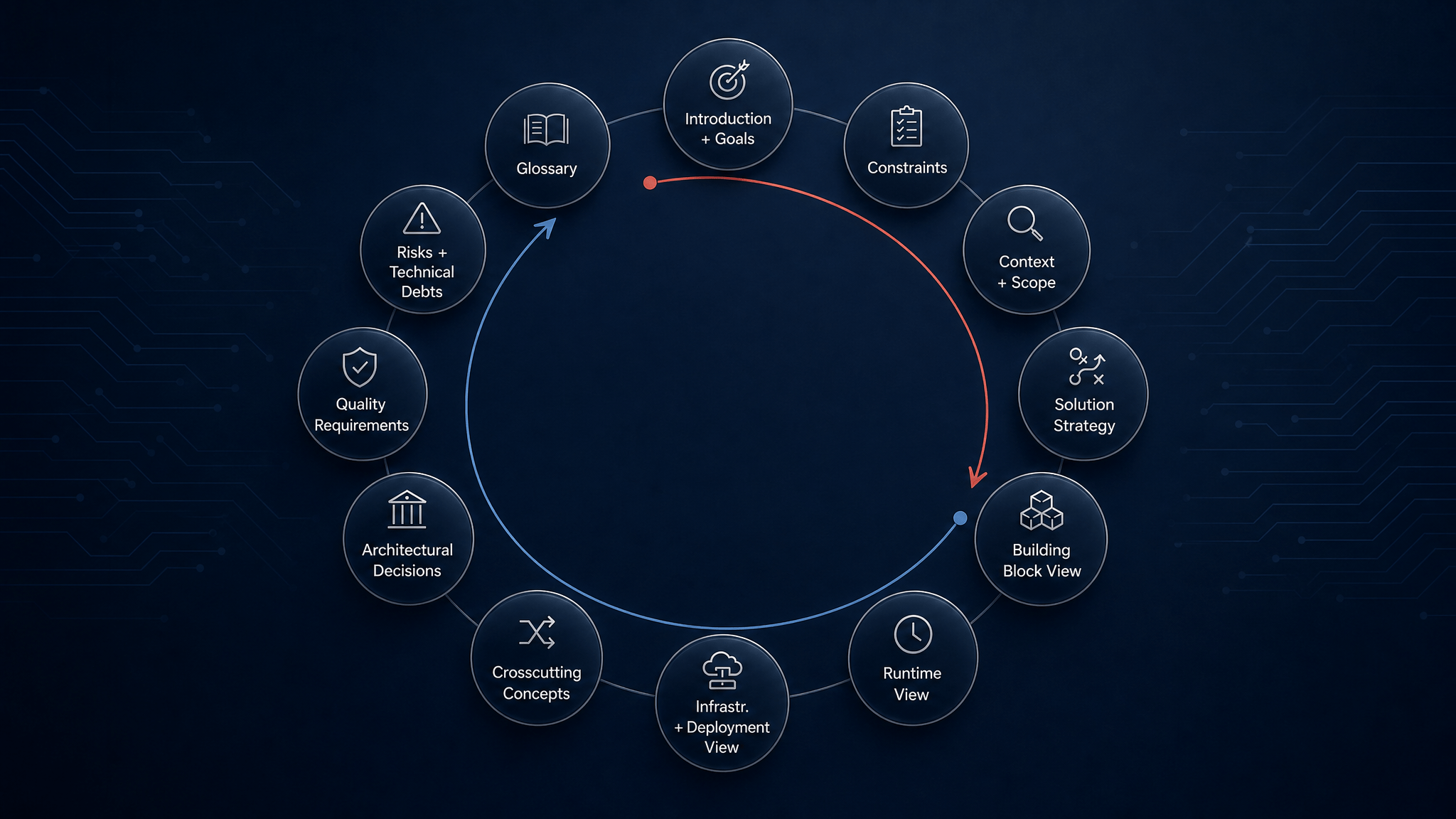
The first was governance design and rollout. MMK DIGITAL defined guiding principles and technology standards tailored to the domain structure, established review boards with clear mandates and decision authority, and introduced Architecture Decision Records to capture rationale and ensure traceability. Lightweight relevance assessments let teams self-identify when governance checkpoints applied.

The second was reference designs and reusable blueprints. MMK DIGITAL developed designs for recurring integration, data, and infrastructure patterns, publishing them using arc42 and the C4 model so delivery teams could consume them directly, and maintaining them as a living resource updated through project feedback.

The third was embedded project delivery support. MMK DIGITAL architects worked inside transformation projects as solution and domain architects, providing design reviews, technical coaching, and hands-on problem-solving. This kept governance grounded in real delivery constraints and turned standards into living tools.

Impact: Enterprise Architecture as the Foundation for Growth

Over three years, the practice matured from an initial framework into a self-sustaining function embedded across the organization.

Decision-making became consistent at scale, as guiding principles and technology standards became the default reference point for teams across all domains. Delivery grew faster and more predictable, because reusable blueprints reduced solution design time and eliminated repeated debates over foundational technology choices. Every significant technology decision was documented and linked to the broader strategy, supporting internal alignment and external audit requirements alike.

The shift from reactive oversight to embedded partnership allows us to build in quality from the start and eliminate the friction of late-stage corrections.

Marc Klein, Principal IT Architect

The shift from reactive oversight to embedded partnership allows us to build in quality from the start and eliminate the friction of late-stage corrections.

Marc Klein, Principal IT Architect

Adoption happened without enforcement, as review boards and checkpoints were used mandatory by the majority of teams because they demonstrably improved outcomes. By 2025, the practice was staffed and operated by the customer’s own people, with MMK DIGITAL transitioning from delivery to advisory. Most importantly, the organization achieved alignment across a highly heterogeneous landscape without sacrificing the autonomy and speed its teams needed. Governance became a delivery accelerator rather than overhead.

Conclusion

Conclusion

Enterprise Architecture is often reduced to governance, documentation, and compliance. At this company, it did far more: it became the central link between the company’s transformation ambitions and the hundreds of delivery decisions required to realize them. As a newly independent DAX company separating from its former parent under hard regulatory and contractual deadlines, out customer needed to make coherent technology decisions across a fragmented, fast-moving landscape of more than 1,000 systems. The answer was an operating model that connected strategy, governance, and delivery into a single, practical discipline

The combination of governance at the enterprise level, blueprints at the domain level, and architects on the ground proved decisive. Standards were shaped by and tested in actual delivery, never theoretical documents on a shelf. By embedding governance into the organization’s transformation programs rather than placing it above them, MMK DIGITAL helped create a practice that teams trusted and used. The result was a more consistent IT landscape, faster delivery, traceable decisions, and a governance function the organization now owns and continues to evolve.

The engagement reflects a principle MMK DIGITAL applies across its work: effective Enterprise Architecture is an organizational discipline that enables transformation, supports sound decision-making, and helps enterprises evolve complex technology landscapes sustainably.

Enterprise Architecture is often reduced to governance, documentation, and compliance. At this company, it did far more: it became the central link between the company’s transformation ambitions and the hundreds of delivery decisions required to realize them. As a newly independent DAX company separating from its former parent under hard regulatory and contractual deadlines, out customer needed to make coherent technology decisions across a fragmented, fast-moving landscape of more than 1,000 systems. The answer was an operating model that connected strategy, governance, and delivery into a single, practical discipline

The combination of governance at the enterprise level, blueprints at the domain level, and architects on the ground proved decisive. Standards were shaped by and tested in actual delivery, never theoretical documents on a shelf. By embedding governance into the organization’s transformation programs rather than placing it above them, MMK DIGITAL helped create a practice that teams trusted and used. The result was a more consistent IT landscape, faster delivery, traceable decisions, and a governance function the organization now owns and continues to evolve.

The engagement reflects a principle MMK DIGITAL applies across its work: effective Enterprise Architecture is an organizational discipline that enables transformation, supports sound decision-making, and helps enterprises evolve complex technology landscapes sustainably.

Conclusion

The starting point for this transformation was a clear recognition of the core challenge: central data provisioning was creating bottlenecks, hindering scalability, and making it difficult to deliver data-driven insights at pace. By shifting to a domain-driven, decentralised ownership model, the organisation overcame these constraints and established a flexible foundation for analytics and AI at scale. Now MMK DIGITAL further supports in creating more data products and enabling teams to deliver even more valuable insights.

This holistic approach – combining architectural rigour, automated governance, and close collaboration across business and IT – ensured that data products could be delivered faster and with greater reliability. Domain ownership, semantic metadata as a first-class deliverable, and enablement at scale proved to be the key factors in making the transformation sustainable. MMK DIGITAL’s role as an embedded architecture partner demonstrated that lasting change happens through working alongside teams, building capability sprint by sprint, and designing systems that grow with the organisation.

Conclusion

The starting point for this transformation was a clear recognition of the core challenge: central data provisioning was creating bottlenecks, hindering scalability, and making it difficult to deliver data-driven insights at pace. By shifting to a domain-driven, decentralised ownership model, the organisation overcame these constraints and established a flexible foundation for analytics and AI at scale. Now MMK DIGITAL further supports in creating more data products and enabling teams to deliver even more valuable insights.
This holistic approach – combining architectural rigour, automated governance, and close collaboration across business and IT – ensured that data products could be delivered faster and with greater reliability. Domain ownership, semantic metadata as a first-class deliverable, and enablement at scale proved to be the key factors in making the transformation sustainable. MMK DIGITAL’s role as an embedded architecture partner demonstrated that lasting change happens through working alongside teams, building capability sprint by sprint, and designing systems that grow with the organisation.

M M K   D I G I T A L

MMK DIGITAL GmbH is an IT architecture consulting company with offices in Germany and Switzerland.

  • Schorndorfer Str. 42,
    71638 Ludwigsburg

For more information visit Data Privacy and Legal Notice.

GET IN TOUCH
M M K   D I G I T A L

MMK DIGITAL GmbH is an IT architecture consulting company with offices in Germany and Switzerland.

  • Schorndorfer Str. 42, 71638 Ludwigsburg

For more information visit Data Privacy and Legal Notice.

GET IN TOUCH
Privacy Settings
We use cookies to enhance your experience while using our website. If you are using our Services via a browser you can restrict, block or remove cookies through your web browser settings. Find more details here on the following page: Privacy Policy
Youtube
Vimeo
Google Maps