
I have never seen a small or medium sized firm outside the tech industry that had such a high motivation for change and the adoption of AI. Nevertheless, the limitations one is facing when building up a sophisticated private AI setup without extensive technical expertise became clear quite quickly.
Cornelius Höfig, Expert IT Architect
Case Study
AI as Competitive Advantage
In Short
Case Study
AI as Competitive Advantage
In Short
The Challenge
A knowledge-driven engineering firm faced growing effort in tenders and project documentation, while early AI experiments failed to deliver reliable results due to unstructured data and technical barriers.
Our Approach
MMK DIGITAL combined strategic sparring, data structuring, and a pragmatic AI architecture to turn scattered documents into a shared, secure, and usable foundation for AI-supported workflows.
The Outcome
The client established a central AI platform used across the company, reduced manual effort significantly, and built sustainable AI capabilities without a dedicated IT department.
Background: Deep expertise but fragmented knowledge
The client is a mid-sized, highly specialized planning and engineering firm with decades of experience across complex projects. Their competitive advantage lies in expert knowledge, long-standing project experience, and the ability to respond precisely to detailed requirements.
Over time, this knowledge accumulated in many forms: documents, PDFs, spreadsheets, folder structures, and personal experience held by individual employees. While this worked in smaller settings, increasing tender complexity and documentation requirements made it harder to reliably access and reuse past project experience.
At the same time, the client recognized the growing relevance of AI. Initial experiments with locally installed tools and public AI services created optimism, but also frustration. Results were inconsistent, technical hurdles slowed progress, and it was unclear why some attempts worked while others failed.
The organization had no dedicated IT or data ownership. Exploration with AI agents happened “on the side,” driven by motivated individuals rather than a shared strategy – making it difficult to move from experimentation to real, repeatable value.
I have never seen a small or medium sized firm outside the tech industry that had such a high motivation for change and the adoption of AI. Nevertheless, the limitations one is facing when building up a sophisticated private AI setup without extensive technical expertise became clear quite quickly.
Cornelius Höfig, Expert IT Architect
Pain Points: High effort knowledge work
One recurring pain point became especially visible during tenders. When questions about past project experience arose, teams had to manually ask around, search through folders, and rely on individual memory or chance. Answers were time-consuming to compile and difficult to verify for completeness.
Meanwhile AI experiments did not scale. Technical issues such as local setup, access, and networking blocked further progress. Another cause of trouble with poor AI agent responses was unstructured and inconsistently prepared data, which was not yet identified as a problem by the client. As a result, AI appeared unreliable, even though the real limitation lay elsewhere.
Key challenges included:
- High manual effort in tenders and documentation and everyday work
- No central, structured view of project experience
- Dependence on individual knowledge holders
- Frustration with AI producing inconsistent results
- Technical hurdles preventing real value creation
Goals & Strategic Guidelines: From experimentation to real capability
he immediate goal was clear: answer tenders faster and more reliably by making project summaries centrally available. At the same time, the firm wanted to continue exploring AI – this time with a setup that enabled learning, experimentation, and long-term reuse.
To drive value creation the solution initially needed to:
- Be secure and suitable for sensitive data
- Enable local, private AI usage without license lock-in
The ambition extended beyond a single use case: build a foundation that allows the organization to grow with AI over time while complexity and cost stay constant.
Cornelius Höfig, Expert IT Architect
The ambition extended beyond a single use case: build a foundation that allows the organization to grow with AI over time while complexity and cost stay constant.
Cornelius Höfig, Expert IT Architect
The focus was on shared understanding, alignment of goals, and incremental progress. During the first alignment sessions MMK DIGITAL helped to establish additional goals, that add immense value but were initially unknown:
- Enable access to central datasets that previously did not exist
- Be accessible to the entire team of engineers and architects on all their devices
- Support both experimentation and productive use cases at the same time
- Remain understandable and operable without deep IT expertise
Chat
Security
Knowledge Management
Deep Research
Analytics
Integration
Automation
More Capabilities
Our Contribution: Sparring, structure, and systems
MMK DIGITAL joined as a trusted advisor to one of the firm’s executives – initially to solve a concrete problem, but quickly expanding into a broader strategic role. From the first session, the focus was on understanding context, data, and goals before touching tools.
MMK DIGITAL’s contribution combined several roles:
- Strategic consulting for leadership
- Translation between domain expertise and AI technology
- Architecture design for data and AI-ready systems
- Troubleshooting technical blockers
- Co-development of concrete, high-value use cases
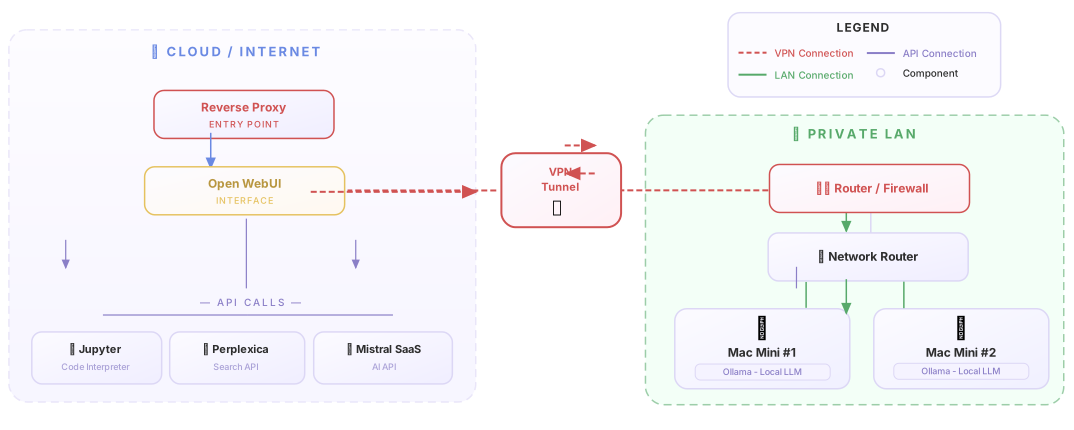
MMK DIGITAL designed an open, cost-efficient architecture based on open-source technologies which helped keep cost and complexity low. Data was normalized, classified, and prepared through automated pipelines to become machine-readable – going beyond simple “chat with PDFs”.
A classic approach that was offered was to separate experimentation and production using containerized environments. This allowed safe exploration while also enabling stable, shared use cases for the entire company. Secure single sign-on was integrated using existing enterprise identity infrastructure – perfectly integrating into the existing ecosystem.
Regular alignment sessions, fast weekly iterations, and joint analysis of results created clarity and trust. Over time, experimentation turned into reliable, scalable solutions.
Impact: A shared AI platform with real value
Today, the firm operates a central AI platform used across the organization. What started as individual experiments has become a shared capability.
Key results include:
- Broad adoption of AI, including by non-experts – more than 50% of all employees adopted the platform within the first two weeks after rollout
- Significantly reduced effort in knowledge-intensive tasks
- Faster, more reliable tender responses
- Improved data quality and transparency
- Substantial cost savings by avoiding per-user license models
During a large introduction workshop employees learned not only how to use AI, but also why it works and where its limits are. Sensitive data can be processed securely, and tools like AI-supported research and document analysis simplify daily work.
Most importantly, the organization moved from isolated initiatives to a platform that continuously creates value.
Conclusion
This story shows that many small or medium companies could already benefit from AI – often without realizing it. The real challenge is rarely the technology alone, but the lack of structure, clarity, and guidance needed to use it meaningfully. In many cases only a small investment is needed to solve key pain points.
With the right partner, even complex fields like AI can be approached pragmatically. By combining strategic sparring, architectural thinking, and hands-on enablement, it is possible to unlock real value in a short time – without building a full IT department or buying into rigid products.
For planning, engineering, and consulting firms with large amounts of documents and experiential knowledge, AI offers vast potential to increase efficiency and quality. The underlying principle that structuring data is a substantial enabler proves to be more true than ever before. When treated as a system – instead of a tool – AI can grow to become a sustainable capability.
MMK DIGITAL can be a trusted partner and enabler of AI capabilities. A robust AI foundation allows companies not only to keep up – but to grow with confidence and create individual competitive advantages.
Conclusion
This story shows that many small or medium companies could already benefit from AI – often without realizing it. The real challenge is rarely the technology alone, but the lack of structure, clarity, and guidance needed to use it meaningfully. In many cases only a small investment is needed to solve key pain points.
With the right partner, even complex fields like AI can be approached pragmatically. By combining strategic sparring, architectural thinking, and hands-on enablement, it is possible to unlock real value in a short time – without building a full IT department or buying into rigid products.
For planning, engineering, and consulting firms with large amounts of documents and experiential knowledge, AI offers vast potential to increase efficiency and quality. The underlying principle that structuring data is a substantial enabler proves to be more true than ever before. When treated as a system – instead of a tool – AI can grow to become a sustainable capability.
MMK DIGITAL can be a trusted partner and enabler of AI capabilities. A robust AI foundation allows companies not only to keep up – but to grow with confidence and create individual competitive advantages.
M M K D I G I T A L
MMK DIGITAL GmbH is an IT architecture consulting company with offices in Germany and Switzerland.
Schorndorfer Str. 42,
71638 Ludwigsburg
For more information visit Data Privacy and Legal Notice.

GET IN TOUCH
M M K D I G I T A L
MMK DIGITAL GmbH is an IT architecture consulting company with offices in Germany and Switzerland.
Schorndorfer Str. 42, 71638 Ludwigsburg
For more information visit Data Privacy and Legal Notice.
